

As a first port of call, I will consider something that most people can digest easily: house prices. As a general statement, house prices in Australia (and in the "west" generally, have risen inexorably since the end of the last great cataclysm. WWII didn't do much for house prices, as especially in Europe, blown up houses tend to have low values. Since then, however, they have risen with a few shocks along the way such as the early 70's oil shock and the crash of the late 80's. There is an aphorism that real estate doubles every ten years. That may be true, but if so it has only been true since 1945, before which virtually every second house in Europe (say) was destroyed twice in a generation and a half. You get my drift?
What we might ask is why have prices risen so much? Is it because we are wealthier? Perhaps. Perhaps a better way to think about it is that we are more indebted, but our "asset" prices have been rising which makes us feel more wealthy. If we can pay the interest, and our house is rising in value, and the bank will keep lending us more for toys, why wouldn't we feel wealthy? Well, because all of this debt is what our house prices are built upon. If the person next to me is able to borrow more, they can pay more, and hence they get the house at the auction. What happens if borrowing seizes up as happened in 2008? The short answer is that everyone trying to borrow either can't, or can't borrow as much. So, a house that was previously worth $500,000, will only be worth, say, $300,000. House prices are, essentially, a mirage built on debt. If the tap turns off, the prices fall down.
This is especially true in the global environment in which we all live, because if one country suffers, many others suffer. For example, Australia is not a nation of savers, or at least has not been overall since 2000. That is, due to a lack of deposits, our banks sought to raise funds for lending off shore. During good times, this money comes relatively cheap, but in bad times the price gets more expensive, and less people can afford to pay the price. In 2008, during the height of the credit crunch, this price went up massively. You may have heard of something called the LIBOR (London Interbank Offered Rate, if you need to know). Essentially this is the interest rate that banks charge to lend money to each other overnight. When banks because suspicious that any bank they lent to may fall over during the night, or simply might have trouble paying their money back, they jacked up their rates. This meant that they also had to put up their rates to people such as you (not me, I don’t have a mortgage or a big credit card debt). So, when the Lehmann Brothers episode hit in September 2008, bank rates flew up, and in this country it was only when the Reserve Bank moved to flood our economy with money (via lower interest rates) did house prices stabilise. Essentially, governments here and elsewhere, went into large amounts of debt to ensure that their various banks didn’t fail. It seems that recently all that effort, and all that debt is for naught, as banks are going to fail regardless, but I’ll leave that for another time. I’ll end with this- high house prices are built upon people’s ability to service debt. If either a) their ability to service debt (job losses), or the amount to service (interest rate rises) changes, house prices go down. What chance a “double dip recession”?
In the next post, I think I'll discuss where we are at with the buffeting that has been happening recently in Europe, and what that whole thing might mean.


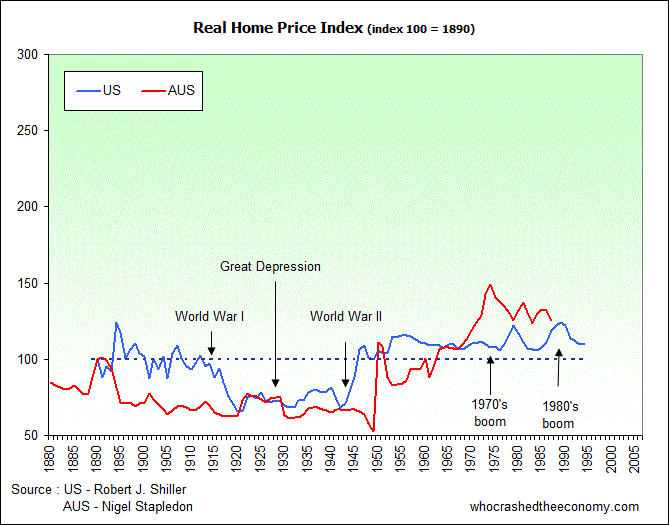

Your graph of house price increases doesn't show what's happened in Oz in the last 20 years - afterall that's where all the action has been.
ReplyDeleteThe graph people really need to see is this:
ReplyDeletehttp://cdn.debtdeflation.com/blogs/wp-content/uploads/2010/05/051110_0038_IsitallSupp1.png
"So, when the Lehmann Brothers episode hit in September 2008, bank rates flew up, and in this country it was only when the Reserve Bank moved to flood our economy with money (via lower interest rates) did house prices stabilise." According to Ross Garnaut it was the government guarantee of the banks that immediately halted the crash. Without that, credit would have tightened here. Instead the RBA dropped rates and the govt started splashing money around to first home buyers and prices surged because the people who can least afford it were suckered into the market. They are the ones that suffer when rates go up.
ReplyDelete"If either a) their ability to service debt (job losses), or the amount to service (interest rate rises) changes, house prices go down. What chance a “double dip recession”?"
The 3rd factor that could cause a crash as you mentioned earlier, is a tightening of credit. If the banks tighten lending (so that 10 or 20% deposit is required to buy a house), then many people are instantly priced out of the market.
There are many, many graphs that demonstrate this. What I was trying to illustrate is that prior to the war, these rices weren't the case. But yes, in the past 20 years (say since crash of 87 even) the price rises have vastly outpaced income growth. Debt growth has basically tracked house prices however.
ReplyDeleteOn the other points, govt and reserve action are what halted the slide that had begun. The First Home Vendors grant (yes the money benefited home owners, not home buyers)and the measures we've both mentioned kept house prices high.